
Just before the recent bout of volatility in the world of digital assets, along with Bitcoin’s (BTC) downward breakout, an unexpected figure grabbed international headlines: Javier Milei emerged victorious in the Argentinean primary election. A candidate of libertarian ideals and a member of the “La Libertad Avanza” party, Milei stands out as a vocal Bitcoin advocate. He perceives Bitcoin as a representation of money’s return to its original creator – the private sector. Additionally, he fervently calls for the abolition of Argentina’s central bank, which he brands as a “scam” and a mechanism used by politicians to deceive citizens through inflationary taxation. This stance is unsurprising in a country notorious for its high inflation rates, currently estimated to exceed about 100% annually. However, Milei’s perspective prompts us to explore broader questions about the global landscape for cryptocurrency holders.
When we encounter the assertion that “Bitcoin is too risky,” particularly as citizens of the U.S. and holders of dollars, it’s important to bear in mind that this viewpoint stems from a position of significant privilege, termed “exorbitant privilege.” The term was coined by French Finance Minister Valéry Giscard d’Estaing in the 1960s, referring to the unique advantages that the U.S. enjoys due to the extensive use of the dollar in global trade, finance, and as a global reserve currency. This global reliance on the dollar grants the U.S. government the ability to print money with minimal repercussions and borrow at lower interest rates compared to other nations, some of which have had tumultuous financial histories, as in the case of Argentina. The dollar’s status as a global reserve currency also simplifies U.S. monetary policy decisions since the Federal Reserve essentially functions as the world’s central bank, influencing other central banks to adopt similar rate strategies to safeguard their exchange rates. This dynamic echoes the blunt words of John Connally, Treasury Secretary under President Richard Nixon: “The dollar is our currency, but it’s your problem.”
So, what has the experience of Bitcoin investment been like for global holders outside the U.S. dollar system? Over the past five years, most Bitcoin holders in non-U.S. regions witnessed more substantial gains in Bitcoin’s value (refer to Figure 1 below). These gains are attributed to the depreciation of their local currencies against the dollar. This phenomenon arises due to the increase in U.S. interest rates, combined with Bitcoin’s 31% return relative to the dollar (depicted as the orange bar for Bitcoin vs. USD return in the chart). Over this five-year span, Bitcoin has shown resilience even against a strengthening dollar.
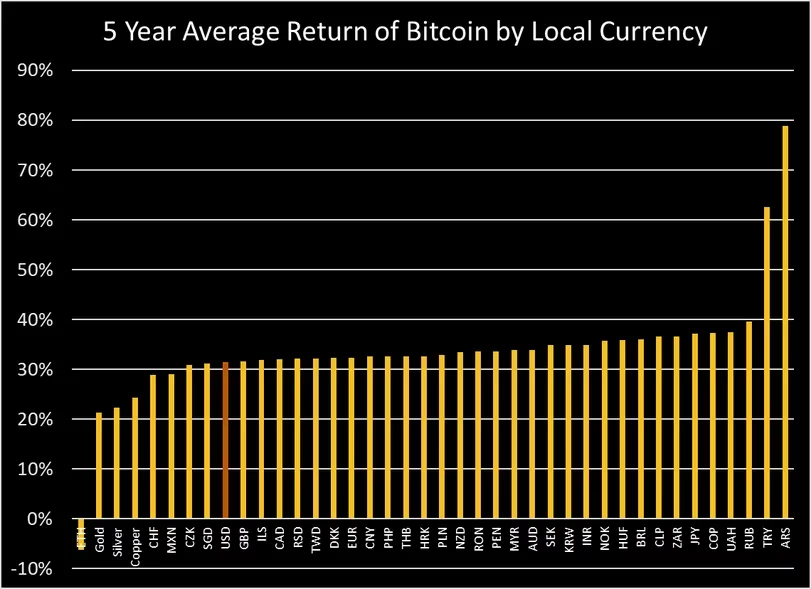
Average five-year return of bitcoin holders by foreign currency. Source: CoinDesk Indices Research, FactSet.
Several notable exceptions can be observed during this period, particularly in Argentina (providing context to Milei’s electoral triumph) and Turkey (whose leader recently shifted back to conventional economic theories following an experiment with “Erdoyanomics” driven by the stimulative effects of lower interest rates). In these instances, with realized inflation rates of 60% for Argentina and 33% for Turkey over five years, Bitcoin holders within these countries found respite from adverse political and economic circumstances. They achieved this by leveraging the decentralized and digital nature of Bitcoin as a store of value.
In conclusion, the recent surge in global cryptocurrency investment and Bitcoin’s ascent have prompted diverse responses from different corners of the world. Milei’s electoral success highlights the growing influence of cryptocurrency advocates, while the exorbitant privilege of the U.S. dollar underscores the unique advantages it holds. Bitcoin holders outside the U.S. have often seen substantial gains due to their local currencies’ depreciation. Notably, individuals in countries like Argentina and Turkey have turned to Bitcoin as a means to preserve their purchasing power amidst challenging economic landscapes. This decentralized and digital store of value has indeed offered a shelter from the storms of localized financial instability.